
There is something about Lagos, about this human chaos, about entering danfos and crawling into kekes and jumping on okadas and pushing against bodies reeking of sweat while dancing between pungent puddles, that makes me wish I could read minds. Maybe not read minds as much as experience what people really feel, like a crude version of Deanna Troi of the Starship Enterprise.
Not all lives interest me. Some people are just derivatives of other people, stock personalities coming out of the human conveyor belt, uninteresting in the way I imagine I must be. But a few stand out: fascinating humans who compel me to observe, like the three girls who piled into the bus behind me in Obalende on Saturday.
They wore clothing that strained against their youth. One sat and two lapped themselves. One pleaded with another in Yoruba, telling her she was sorry. Let us go to Alhaji’s place, she said. The friend replied, You can go, I’m not going. She pleaded again, I am sorry. They repeated this as more people hauled their bodies into the bus. I took a bite of gala, and a swig of Lucozade Boost. I said I’m sorry, she said, again, rubbing her friend’s low-cut hair aggressively, like a broken version of the act of ruffling the hair of a loved one in affection. Their third friend was silent throughout this exchange. The friend finally gave in: Okay, we can go. As she said that, the last spot in the bus was filled and the conductor was already asking the driver for his pay.
Shift, shift, we want to go down, the one who had been pleading with her friend shouted to the other people on their seat. They were in the back seat. The man seated beside them did not bulge, he looked at the girl, and turned up his nose in what looked like scorn. Mtscheww! We’re telling them to move and they are just sitting there like they are deaf, she said to the rest of the bus.
Who is Alhaji? Why is the need to visit him this strong a few minutes past 6pm? It bothers me that there is a whole swathe of human experience and emotions I do not have access to. It bothers me that this bothers me.
As we sped along Third Mainland Bridge, the same girl who had been pleading so she could visit Alhaji received a call and spoke to a guy who, from what I could gather, was expecting her. I’m at home now, she told him. She spoke in a heavily accented English that had that slant and hesitation that shows the speaker has the basic vocabulary for fluent communication in English, but is actively translating from Yoruba in her mind.
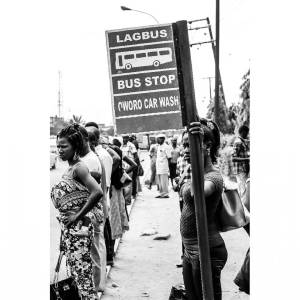
At Oworonsoki, the trio started a Yoruba christian song, the kind I last heard in one of my many homes, from the mouth of choristers in long robes chanting enthusiastically to the rhythm of gangan. There was so much cheer in the girls’ voices, and they giggled intermittently as we moved on to Oshodi.
That moment, I remembered a small boy, barely in his teenage years, who was the conductor in a bus I took from Isolo to Oshodi earlier in the week. His body stank. The moment one of the passengers commented on it, he lashed back and insulted everyone in the bus. The more he spat out at other people, the more I realised I couldn’t even imagine his mental state, not to talk of the physical. What could have gotten a boy who should be running around a school playground in pristine uniform to the side of a bus, dangling, insulting others, courting death?
I hope one day to have the courage to ask these people for their stories. I want to see their stories told with care and empathy, in a way that will make me see them as they are, not just as the world labels them.
I alighted from the bus and took the overhead bridge. I looked down and saw the three girls walk towards Ilupeju. I hope, somewhere at the end of their journey, there’s someone waiting for them who calls them Imzadi* in a way that is not predatory. I hope there’s someone who knows their story, and cares deeply about them.
____________
*In Star Trek: The Next Generation, Will Riker, Deanna Troi’s love interest, calls her Imzadi, which translates roughly, in the Betazed language as Beloved. It is what she called him the first time they met.
Featured image by Angela C. via Flickr
Owonronsoki by Logor Olumuyiwa, whose Monochrome Lagos you should check if you’re fascinated by this mad city.
 ifeOluwa nihinlola